Diversity, Equity, Inclusion & Belonging

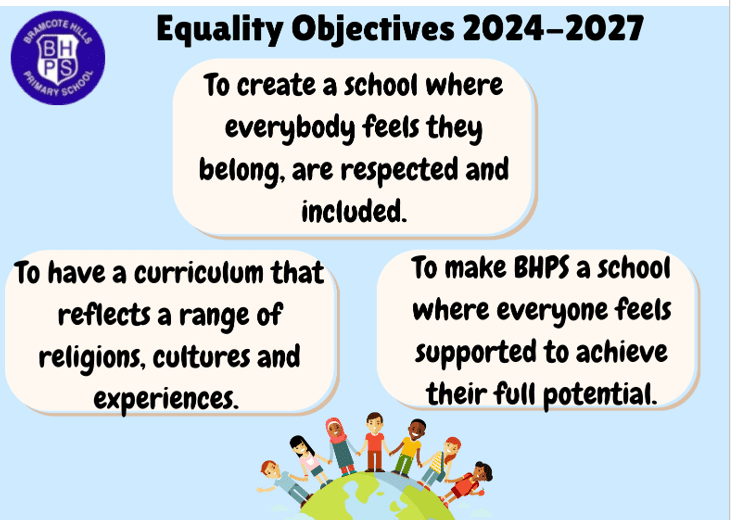
At Bramcote Hills Primary we are fortunate to have a diverse school community. We strive to provide a school community that respects, values and celebrates differences.  Throughout the school year we celebrate many different events, such as Diwali, Lunar New Year, Mental Health week and Wellbeing week.

Our school has a team of Diversity Champions from Key Stage Two who meet once every half-term. This provides children in our school a voice to share their thoughts on diversity, equality and inclusion within our school and ways we can build upon and improve our practice.

We are committed to providing an inclusive education for all our pupils that recognises the nine protected characteristics stated in the Equality Act of 2010. Through teaching these children gain an understanding of the world in which they are growing up in and develop a respect towards people who hold these characteristics.
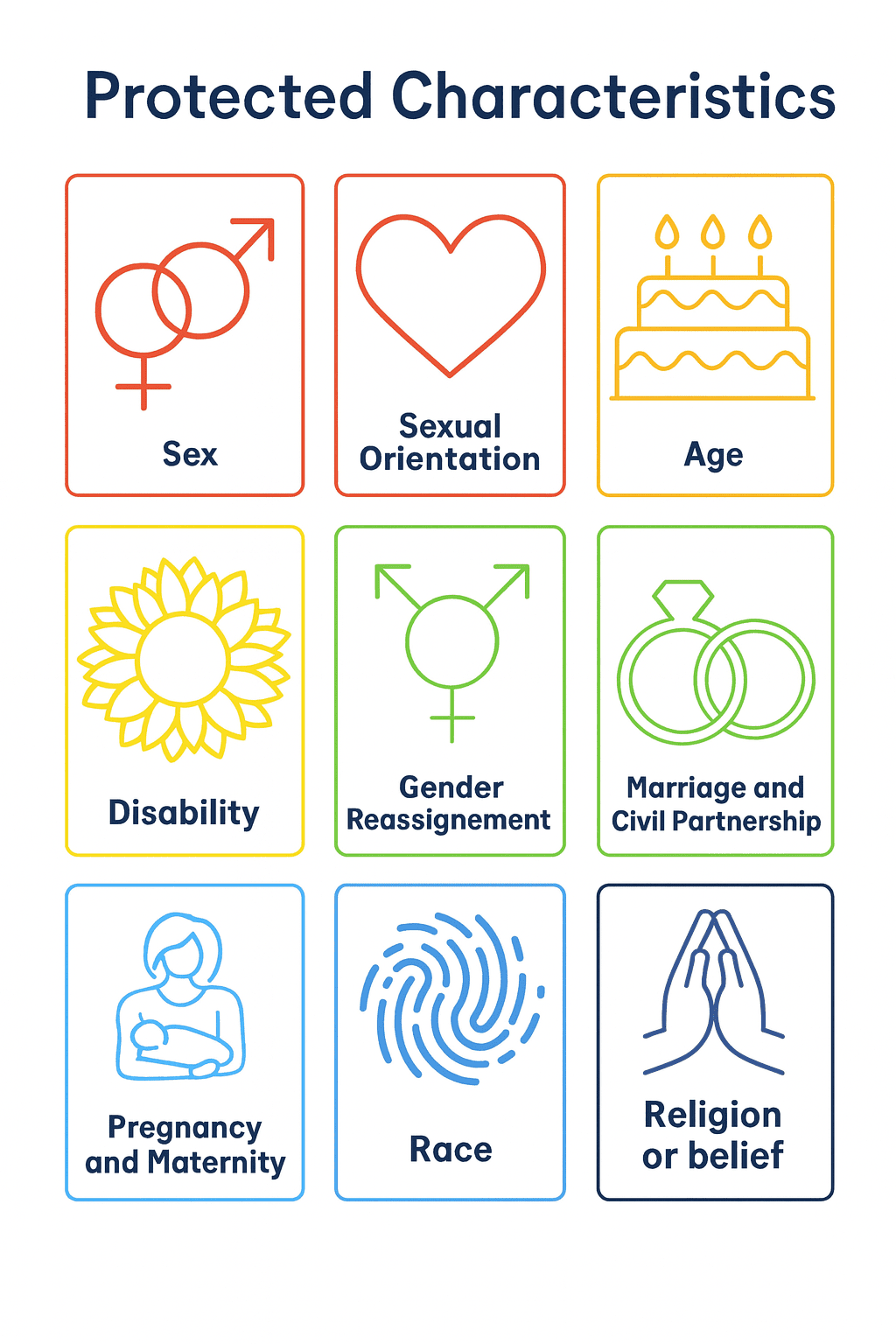
The Protected Characteristics are as follows:

  • Sex (gender)
  • Disability 
  • Age
  • Religion or belief
  • Marriage and Civil partnerships (families)
  • Pregnancy or maternity
  • Sexual orientation
  • Gender reassignment

We teach about these Protected Characteristics in line with our Jigsaw PSHCE scheme of work and at an age appropriate level. In Foundation and Key stage One we prioritise our teaching of the characteristics highlighted in bold.

Promoting British Values at Bramcote Hills Primary School

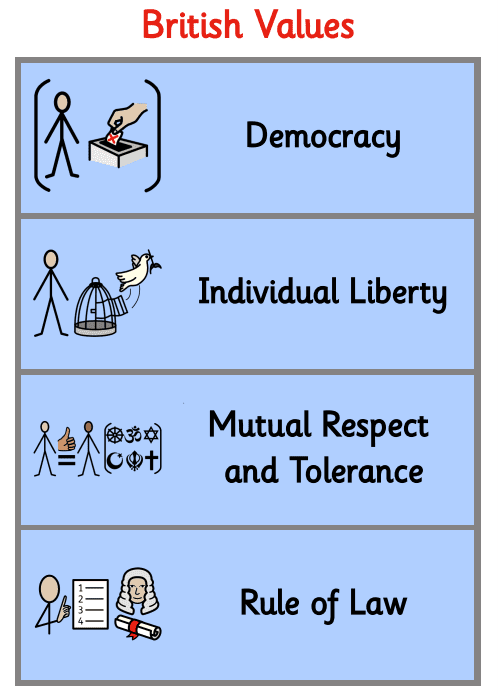
At Bramcote Hills Primary School, we celebrate the diversity of our pupils, families and wider community. We are committed to promoting equality, respect and inclusion, in line with the Equality Act 2010, the Prevent Duty (2015) and the Department for Education’s guidance on Promoting Fundamental British Values.

The DfE defines British Values as:

  • Democracy
  • The Rule of Law
  • Individual Liberty
  • Mutual Respect
  • Tolerance of those with different faiths and beliefs

These values are embedded across school life, the curriculum, and our ethos. We aim to nurture confident, compassionate and responsible citizens who positively contribute to British and global society.

How We Promote British Values

Democracy

  • Pupil voice is central to school life, including through the School Council and Eco Reps.
  • Children regularly vote on decisions, contribute ideas, and take part in debates.
  • Democratic values are explored through PSHE, assemblies and curriculum topics

Individual Liberty

  • Children are supported to make safe, informed choices in a secure environment.
  • We promote independence, self-confidence, and personal responsibility.
  • Pupils learn about rights and freedoms through PSHE, online safety, and pastoral support.
  • A strong safeguarding and anti-bullying culture underpins all we do.

Mutual Respect and Tolerance

  • Respect is a core value and is modelled by staff and pupils.
  • Our curriculum (including RE and PSHE) fosters understanding of different faiths, cultures and perspectives.
  • We welcome visitors from a range of backgrounds and organise visits to places of worship.
  • Discriminatory behaviour is not tolerated and is actively challenged.
  • Our global curriculum promotes cultural diversity, with themes that encourage empathy and awareness.

Rule of Law

  • Our “Five School Rules” are consistently reinforced and understood by all.
  • Pupils learn to distinguish right from wrong and the importance of laws in school and wider society.
  • We work with local services such as the police and fire service to deepen understanding.
  • Year 6 pupils take part in the DARE programme, focusing on legal and ethical choices.

Anti-racist Education Programme (A.R.E.P)

Aims of the A.R.E.P Component of Learning

  • To seek to promote and inspire a sense of belonging, inclusion and social justice for our children, staff and the wider community
  • To be certain it is understood that racism in any form has no place in our society
  • To ensure our education system provides an opportunity for learning, discussion and building confidence in pupils and staff to help eradicate racism.

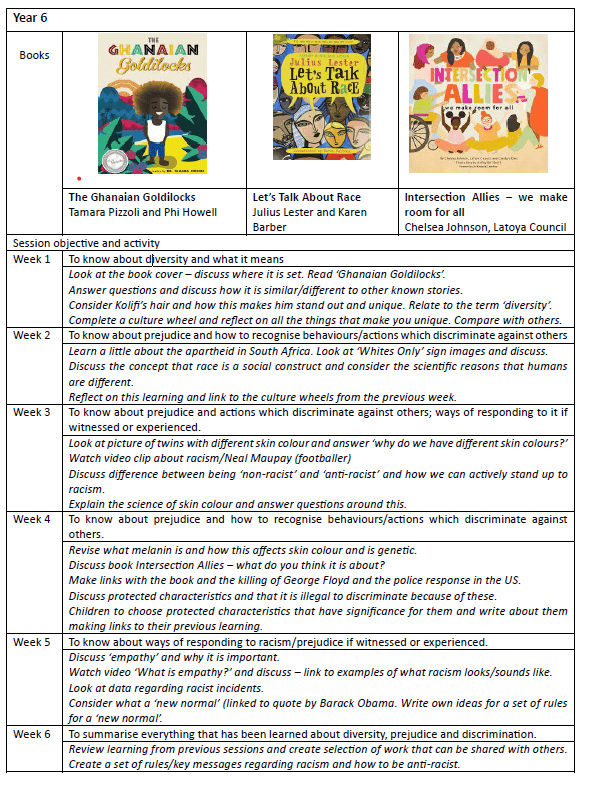
Over the past six weeks, a group of our Year 6 pupils have had the opportunity to take part in the A.R.E.P. programme, guided by Deepa Vasudevan from Nottinghamshire’s Achievement and Equality Team. Their effort, maturity and commitment have been outstanding, and we are incredibly proud of all they have achieved.

Through the programme, pupils explored issues around prejudice and discrimination, discussing examples they have seen or heard and developing a clearer understanding of why certain language is considered racist and inappropriate. Their thoughtful engagement has been inspiring, and the learning they have gained will stay with them well beyond the project. Some examples of the completed work can be viewed in the images below.

During the Spring term, all pupils from Year 1 to Year 5 will take part in a six-week unit of learning that complements our existing PSHCE curriculum. Every child will engage with the A.R.E.P. component, which builds their understanding of what racism is and supports them in becoming actively anti-racist.

Our school staff have received training from Deepa Vasudevan, the author of this scheme of work and a member of Nottinghamshire’s Achievement and Equality Team.

This anti-racism learning is age-appropriate and delivered through carefully selected books and resources. Pupils will explore similarities and differences, bullying, and racism in a supportive environment that encourages thoughtful discussion. We look forward to seeing this work continue across the school and extend our thanks to Deepa for her invaluable guidance during the launch of the project.

Click on the tabs to find out more about some of our special events in school.
Would you like to see more of the work undertaken in school?
Why not pop in and take a look at our Religious Celebrations book, which showcases a range of festivals and celebrations to reflect our rich and diverse school community.

As part of our whole-school Diwali celebration, pupils across all year groups deepened their understanding of the Festival of Light and its significance for Hindus, Sikhs and Jains. Children learnt about the story of Rama and Sita, explored the themes of good triumphing over evil, and discussed how families prepare for Diwali through cleaning their homes, wearing new clothes and exchanging gifts. Classes investigated how Rangoli patterns and light are used to welcome the goddess Lakshmi, and reflected on the values of hard work, virtue and bravery associated with her blessings.

Year 1 immersed themselves in the traditions of India, learning about Jaipur Elephant parade. They worked collaboratively to create their own colour elephants, which were displayed outside during the ‘Colour Run’ event.

Year 3 looked at rangoli designs. These are usually made during festivals and celebrations becuase they are though to bring good luck. Many rangoli designs are symmetrical and include geometric shapes, as well as lots of curved and straight lines.

The community were invited to join our Holi celebration by attending the colour run. This was a fantastic opportunity for families to join together and really capture the essence of the festival.

Celebrating Kindness, Equality and Sharing at Our School

During Autumn Term (2) our whole school has been exploring the theme “Kindness, Equality and Sharing – The Teachings of Guru Nanak.” Through stories, discussion, creativity and reflection, pupils from EYFS to Year 6 have taken part in a special RE focus designed to deepen their understanding of Sikh beliefs and values.

Across the week, children learned about Guru Nanak, the founder of Sikhism, and why his teachings continue to inspire millions of people today. Each phase focused on an age-appropriate concept — from recognising special and kind people in F2, to thinking about how Guru Nanak’s messages can help us make the world fairer in Year 6. Lessons linked directly to our SACRE strands, encouraging pupils to learn about religionlearn from religion, and express their ideas creatively.

Our KS1 assembly introduced children to the story of young Nanak and the “true bargain,” helping them think about how simple acts of kindness can make a big difference.
In KS2, pupils explored how Guru Nanak’s message of equality is still relevant today, reflecting on fairness, inclusion and the importance of treating everyone with respect.

As part of our whole-school celebration of Lunar New Year, each year group learnt about the festival and its significance for the Year of the Dragon. School was decorated with lanterns, artefacts and a Dragon’s Head, creating an immersive environment for pupils and visitors. Members of the school community were invited to share their experiences, enriching children’s understanding. The week concluded with a ‘Showcase’ assembly, during which selected pupils from each year group explained what they had learnt. To mark the occasion, the kitchen served a Lunar New Year meal, helping raise awareness of the celebration across the school and within the local community.

Year 2 learnt all about the significance of the dragon in the Lunar New Year celebrations. They even created their our dragon dance. Click on the link below to view it.

During our whole-school Ramadan Day, pupils developed a meaningful understanding of Ramadan as a month of prayer, reflection and charity. Following assemblies introducing the significance of the period, each year group explored key themes at an age-appropriate level, including why Muslims fast, the importance of community, and the values of gratitude and kindness. Children learnt about how families prepare for Ramadan and Eid-al-Fitr, and discussed the significance of the sun and moon in marking the lunar calendar. Across the school, pupils contributed to our Gratitude Tree by writing personal reflections on what they were thankful for, helping them recognise and appreciate the ‘small things’ often taken for granted. Year-group activities included creative art responses, good-deed calendars, and reflections on the impact of charity, strengthening pupils’ understanding of compassion and generosity. Community members were welcomed to share their experiences, and the week concluded with a showcase newsletter highlighting the rich learning that took place across the school.

As part of our whole-school learning focus on the story of Moses, pupils in every year group explored key themes from the narrative Foundation Stage children learnt about the idea of protection, discussing how baby Moses was kept safe by being placed in a basket on the river. In Years 1 and 2, pupils studied the moment Moses encountered the burning bush and reflected on how he trusted and obeyed God; they linked this to the school rule “follow instructions first time” and produced writing and artwork to deepen their understanding. Years 3 and 4 investigated the theme of slavery through the events of the ten plagues. Year 3 explored what life might have been like for an enslaved Hebrew, writing from the perspective of someone living through that experience, while Year 4 considered Moses’ and Pharaoh’s contrasting viewpoints through conscience-alley drama. In Years 5 and 6, pupils explored the theme of freedom, discussing what freedom means to them and linking this to the significance of Passover. They created poems expressing ideas of liberation within the story and their own lives, with Year 6 also engaging in thoughtful discussion about the importance of living respectfully in a multi-faith society.

Privacy Overview
Bramcote Hills Primary School

This website uses cookies so that we can provide you with the best user experience possible. Cookie information is stored in your browser and performs functions such as recognising you when you return to our website and helping our team to understand which sections of the website you find most interesting and useful.

Strictly Necessary Cookies

Strictly Necessary Cookie should be enabled at all times so that we can save your preferences for cookie settings.

Third Party Cookies

This website uses Google Analytics to collect anonymous information such as the number of visitors to the site, and the most popular pages.

Keeping this cookie enabled helps us to improve our website.